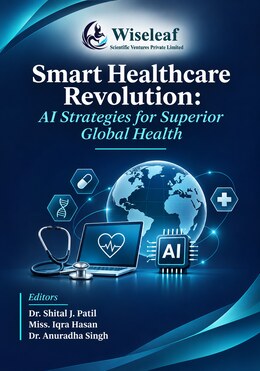
Smart Healthcare Revolution: AI Strategies for Superior Global Health
A peer-reviewed, open-access edited volume in ten chapters
Edited by Dr. Shital J. Patil, Miss. Iqra Hasan, & Dr. Anuradha Singh
About this Book
Artificial intelligence entered medicine long before it entered public conversation. Rule-based consultation programs were being tested at the bedside in the 1970s, yet for decades they remained curiosities. What has changed in the past ten years is scale: deep learning, cheap computation and the digitisation of health records have moved AI from the laboratory into regulatory dossiers, screening programmes and hospital workflows. The question for health systems is no longer whether these tools will arrive, but whether they will be validated, governed and deployed in ways that serve patients everywhere, and not only those in well-resourced settings.
This volume brings together ten chapters that approach that question from different directions. The opening chapter traces the evolution of AI in global health, from expert systems to foundation models, and sets out the governance instruments now shaping the field. The chapters that follow examine specific clinical domains: cardiovascular risk prediction, AI-assisted robotic surgery, digital interventions for mental health disorders, the diagnosis of autism spectrum disorder and of polycystic ovary syndrome, and rare disease diagnosis, where patients are few and every record matters. Two chapters address the systems behind such tools, one on federated learning across hospital networks and one on a digital framework for greener pre-dialysis kidney care. The final chapter turns to the hardest test of all, scaling AI solutions in low-resource healthcare settings.
The book is intended for students, researchers, clinicians, pharmacists and policymakers who want a grounded account of what AI can and cannot yet do in healthcare. Each chapter reports what the published evidence actually shows, with attention to India and other low- and middle-income countries throughout, alongside the global literature.
Each chapter is independently peer-reviewed and available for free download and online reading. The complete volume is published under a single Creative Commons Attribution-NonCommercial (CC BY-NC 4.0) licence and a single book-level DOI.
Table of Contents
About the Editors