
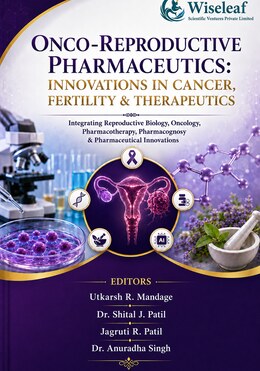
Onco-Reproductive Pharmaceutics: Innovations in Cancer, Fertility & Therapeutics
A peer-reviewed edited volume in fifteen chapters
Edited by Utkarsh R. Mandage, Shital J. Patil, Jagruti R. Patil, & Anuradha Singh
About this Book
Cancer and reproduction were, for a long time, studied as if they belonged to separate clinics. A patient was treated for a tumour, or counselled about fertility, and the two conversations rarely met in the same room. That separation has become untenable. Cancers are being diagnosed earlier in life, survival after treatment is longer, and the hormonal, metabolic and environmental pathways that shape reproductive health turn out to be the same pathways that shape malignant transformation. Onco-reproductive pharmaceutics is the discipline that grows out of that overlap, and this volume is an attempt to give it a coherent shape for students, researchers and practising pharmacists.
The book moves from cause to consequence to intervention. The opening chapters trace how reproductive biology sets the stage for cancer risk: puberty programming and lifetime susceptibility, polycystic ovary syndrome and endometriosis and their oncological associations, cancer diagnosed during pregnancy, and the carcinogenic consequences of the menopausal transition. The middle chapters turn to mechanism, examining the microbiome and cancer axis, epigenetic regulation in reproductive malignancy, endocrine disrupting chemicals, hormone-dependent tumours and viral oncogenesis. The closing chapters address what clinicians and formulators can actually do, covering oncofertility pharmacology, drug resistance, personalised medicine, herbal therapeutics, advanced drug delivery systems, and the growing role of artificial intelligence in this field.
Every chapter has been written by researchers and teachers working in the area it describes, and each stands on its own as a referenced review with its own abstract, keywords and bibliography. Readers who want a single thread through the subject will find one by reading in sequence; readers who arrive looking for a particular topic will find each chapter complete in itself. We have deliberately kept the balance between mechanistic depth and clinical relevance, because the questions in this field are rarely answered from one side alone.
Each chapter is independently peer-reviewed and has its own dedicated page with title, authors and abstract. The complete volume is available for purchase and is published under a single book-level DOI.
Table of Contents
About the Editors